You shouldn’t need a computer science degree to sit through a meeting about AI. Unfortunately, some of the terminology makes it feel that way.
Here’s a plain-English cheat sheet for the terms you’re increasingly going to hear, whether you’re evaluating a new tool, sitting in on a sales pitch, or just trying to follow the conversation without nodding along blindly.
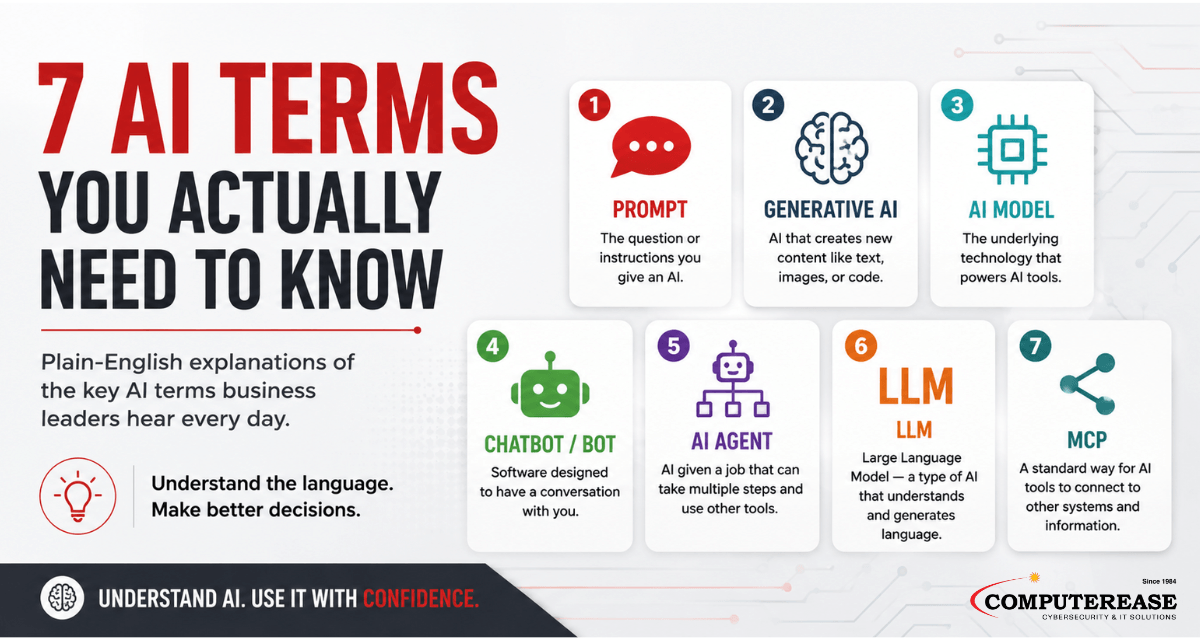
Prompt — The question or instructions you give an AI. What you type is the prompt. A better prompt, one with more detail about what you actually want, usually gets you a better answer. Think of it like giving directions to a new employee: the more specific you are, the less guessing they have to do.
Generative AI — AI that creates something new, text, images, summaries, audio, or code, based on what you ask it to do. This is the category most business tools fall into today, from drafting an email to building a first-pass marketing flyer.
AI Model — The technology actually doing the work behind the scenes. ChatGPT, for example, is an application that can run on different models. Different models are better at different jobs, the same way one employee might be great with numbers and another better with writing.
Chatbot — Software built mainly to talk with you back and forth, like a customer service window on a website. Most chatbots only answer what’s asked. They don’t go do anything on their own.
AI Agent — AI given a specific job that can take multiple steps on its own, sometimes using other tools, to get it done. This is different from a chatbot that just answers questions. An agent might check your inbox, pull a file, and update a record, all without you clicking through each step.
LLM (Large Language Model) — The type of AI model trained to understand and write language. It’s the engine behind most of the AI tools you’ve heard of, including the one answering your questions in ChatGPT or Copilot.
MCP (Model Context Protocol) — A common way for AI applications to connect to outside tools and information, like your files or business systems. Think of it as a standard plug that lets different AI tools talk to the software you already use, instead of every company building its own one-off connection.
You don’t need to memorize every AI term. You just need enough practical understanding to follow the conversation, ask better questions, and decide which tools are actually worth your time. Need help making AI practical for your business? Start with AI training or an AI strategy conversation so your team can use the right tools with clarity, confidence, and security in place