-
Chicago: 312-554-7550
-
St. Louis : 314-432-1661
-
Metro East IL : 618-346-8324
-
Central IL : 217-528-0500

You'd Never Buy an Alarm System Without a Monitoring Company. Why Is Your IT Security Any Different?
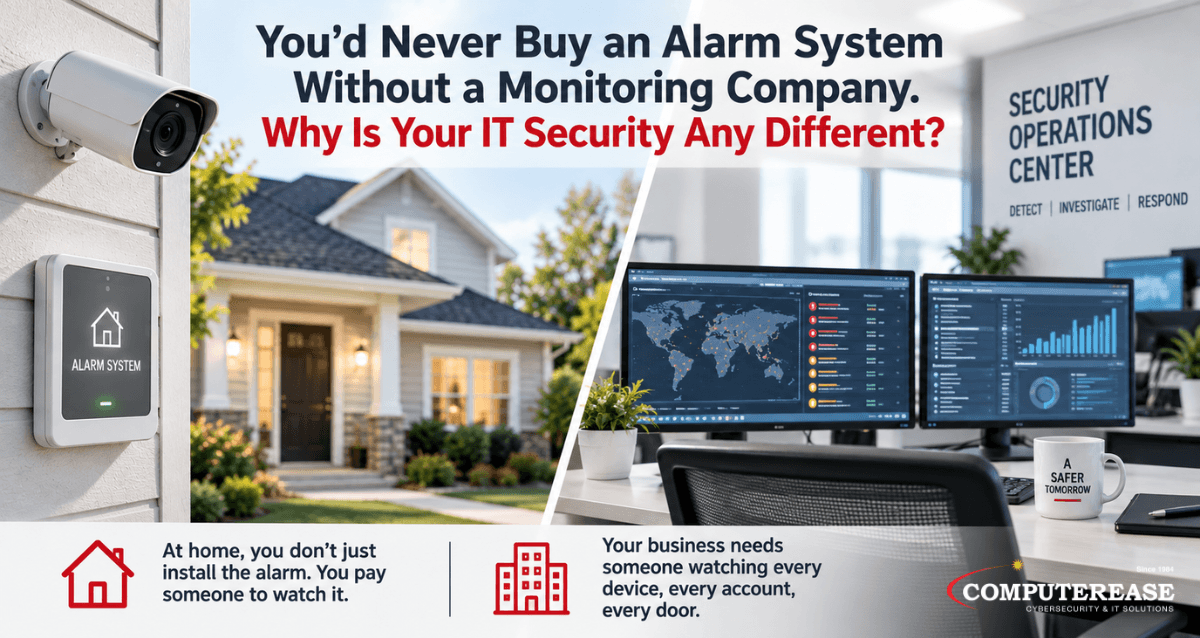
Picture your house with a security system installed. Cameras on the front and back doors. Sensors on every window. A loud siren ready to go off the second something trips it.
Now picture buying all of that and stopping there. No monitoring company. No one watching the feed. Just sensors, quietly doing their job, with nobody on the other end.
Nobody does that. You buy the cameras and the sensors, and you pay a monitoring company to actually watch them. That’s not an upgrade. That’s the whole point of the system.
So here’s the question worth asking: if you’d never protect your house that way, why is that how a lot of businesses are protecting everything they run on?
The Alarm Only Matters If Someone Answers It
Say that alarm goes off at 2am. There are two ways that night can go.
In one version, the monitoring company sees it within seconds. They call you. They call the police. Someone is already responding while it’s still happening.
In the other version, the siren blares into an empty house. Maybe a neighbor hears it. Nobody calls anyone. You find out what happened when you wake up in the morning.
Same alarm. Same sensors. Same detection. Completely different outcome, because of one thing: whether a person was actually watching when it mattered.
That’s the part that gets missed with business security tools. Endpoint protection, firewalls, spam filtering, multi-factor authentication, these are the cameras and sensors. They’re doing exactly what they’re supposed to do. But a tool that raises an alert isn’t the same as someone deciding what that alert means and acting on it in real time.
Your Business Isn’t a House. It’s a House With a Hundred Doors.
Here’s where the comparison needs to go further, because a house only has so many ways in. A few doors. A handful of windows. One alarm system covers it.
Your business isn’t built like that. Every employee laptop is a door. Every phone is a door. Every Microsoft 365 account is a door. Every employee logging in from home, from a hotel, from a coffee shop before a meeting, that’s another door that didn’t exist ten years ago when “the office” was the only thing anyone had to protect.
A business with 50 employees doesn’t have 50 things to watch. It has devices, accounts, cloud applications, and locations that add up to dozens or hundreds of entry points, all active at once, all capable of their own version of 2am.
That’s not a bigger version of the house problem. It’s a different kind of problem.
Why the Math Works Against You
One door, left unlocked once a year, is bad luck. Fifty doors, each left unlocked occasionally, is a near certainty that something eventually gets tried.
One employee’s account flagged once is noise, easy to miss, easy to explain away.
Fifty employees across a dozen devices and cloud accounts means alerts happening constantly. Somebody has to be watching all of them, not just the one that happens to stand out.
That’s the real gap. It’s not that businesses lack tools. Most already have solid ones in place. It’s that having a tool catch something and having a person respond to it are two different jobs, and as the number of doors grows, that gap gets more expensive to leave open.
Two Questions Worth Answering
Forget the tools for a minute. Ask two things instead.
When something happens, is anyone actually watching, right now, at any hour, not just during business hours, not just when someone happens to be at their desk?
And do you even know how many doors your business actually has to watch in the first place?
Most owners have never counted. It’s not a number anyone hands you.
Most owners can answer neither question with any confidence. Not because they haven’t thought about security, or don’t care about it, but because nobody’s ever laid it out for them the way an alarm company lays out a house before you sign up for monitoring.
You already understand this trade-off every time you pay a monitoring fee at home. The sensors alone were never the service. Someone actually answering them, every time, is the part you’re paying for.
Your business runs on the exact same trade-off. It just comes with a lot more doors than most owners ever stop to account for.
Every Business Needs Someone Watching Every Door
A lot of IT companies will sell you the cybersecurity products, fewer of them actually watch what those tools find. At Computerease, our 24/7/365 Security Operations Center monitors every device, every account, and every login.
Ready to see where you stand? We’ll map your business’s vulnerabilities and how to get the security monitoring you need.
AI-Driven Activity Can Make Monitoring More Complicated
Traditional cyberattacks often involve an attacker trying to obtain access they aren’t supposed to have.
AI agents introduce another scenario businesses need to consider: authorized access being used in an unintended way.
An AI agent might be operating through legitimate credentials, approved applications, APIs, and integrations. Individual actions could therefore look normal even when the overall behavior isn’t what the business intended.
That means security teams increasingly need to ask not only whether an account was authorized to access something, but whether the activity performed with that access makes sense.
This becomes more important as AI tools move from helping employees create content to independently performing business tasks.
Do You Know What Your AI Tools Can Access?
As businesses give AI tools access to company data and applications, understanding those permissions becomes part of cybersecurity.
Our Free Cybersecurity & AI Risk Assessment can help identify gaps in your current security environment and start the conversation about how AI is being used across your business. You’ll get a clearer picture of where your business stands and what deserves attention first.