-
Chicago: 312-554-7550
-
St. Louis : 314-432-1661
-
Metro East IL : 618-346-8324
-
Central IL : 217-528-0500

Co-Managed IT vs. Hiring Another IT Person: Which Fills the Gap?
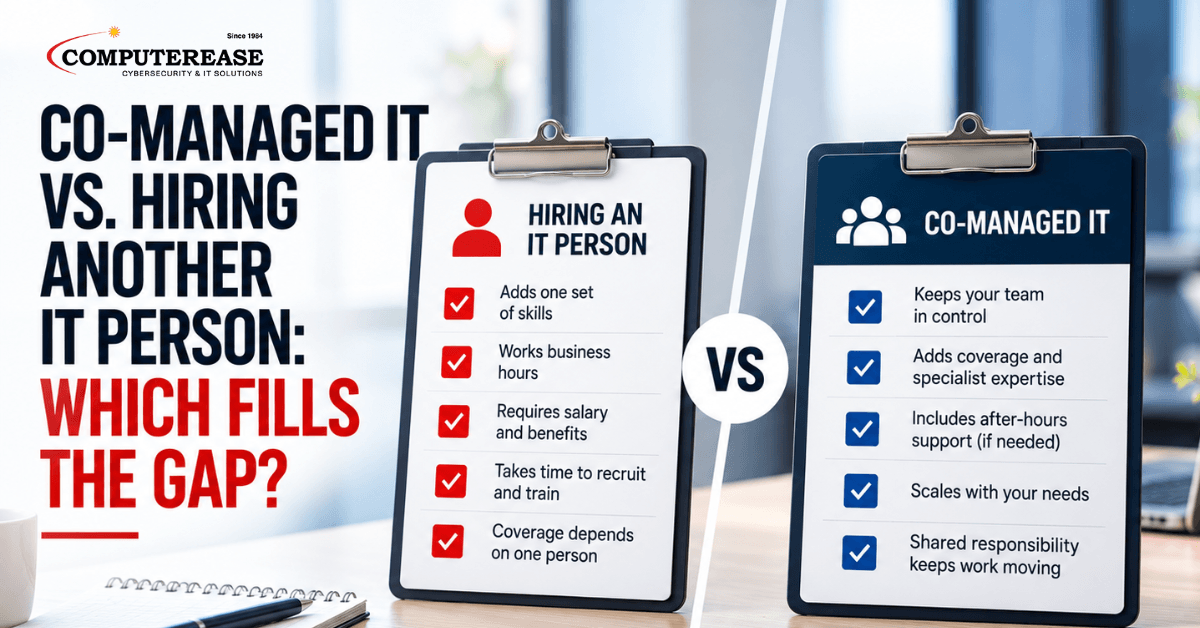
If your business has an IT person or a small IT team, you have probably heard some version of this: “We need more help.” Tickets are piling up. Projects keep slipping. Nobody wants to be the one on call every weekend.
The obvious answer is to hire another IT person. Sometimes that is the right call. But it is not the only option, and it does not always fix the problem you are actually trying to solve.
The other option is co-managed IT. That means your own IT person or team stays in charge, and an outside IT company adds support around them. That support can be help desk overflow, after-hours coverage, security tools, or specialists for the problems your team does not see every day.
This article compares the two in plain English, so you can decide which one fills your gap.
The short answer: When comparing co-managed IT vs. in-house hiring, the key difference is coverage. Hiring adds one more person with one set of skills, working one schedule. Co-managed IT keeps your team in control while adding coverage, tools, and expertise that a single hire usually cannot provide. If your gap is daily, hands-on workload in one specific area, a hire may be the better fit. If your gap is after-hours coverage, specialist knowledge, or backup for the person you already have, co-managed IT usually covers more ground.
What Co-Managed IT Is, and Who It Is For
Co-managed IT is built for businesses that already have internal IT staff. It is not a replacement for them. Your team keeps deciding priorities, owning the systems they know best, and working with your employees every day. The outside partner fills in where your team is stretched thin.
It is not the right fit for everyone. If your business has no internal IT person at all, fully managed IT services are usually the better model. And if you need someone physically on site every day for one specific job, a hire may simply make more sense.
Co-Managed IT vs. In-House Hiring: Five Ways They Compare
1. Who stays in charge
With a new hire, ownership stays fully inside your company, which many owners like. With co-managed IT, it stays there too. Your IT lead still sets the direction, and the partner works within the priorities your team defines. In both cases, you are not giving up control. The difference is whether your IT lead manages one more employee or directs an outside team.
2. After-hours coverage
A second hire usually works business hours. Covering nights and weekends means a rotation between two people, which can lead to burnout, or paying for on-call time. A co-managed partner can provide after-hours and weekend support as part of the agreement, so your team is not the only line of defense at 2 a.m.
3. Access to specialists
Every IT person has strengths and gaps. One hire might be great with networks but new to security, or strong on Microsoft 365 but light on firewalls. A co-managed partner gives your team access to people who focus on security, cloud, networking, and projects, without hiring each of them.
4. Workload
A hire adds about 40 hours a week of capacity in whatever that person does best. That helps if the gap is steady, predictable work. It also adds a salary, and pay depends on the role. According to the U.S. Bureau of Labor Statistics, the median annual wage in May 2025 was $61,860 for help desk technicians and $99,130 for systems administrators. That is before benefits, recruiting, training, and tools. Co-managed IT can add capacity for a busy project without a permanent hire, and the cost is based on the coverage you include.
5. Accountability
With a hire, accountability is clear, because one person owns the work. But it is also concentrated. If that person is sick, on vacation, or leaves, the work slows or stops. With co-managed IT, responsibilities are written into the agreement, so it is clear who handles what. And coverage does not depend on one person being available.
Where Hiring Has the Edge
A fair comparison has to give hiring its due. A new employee is on site every day, which matters if your business has a plant floor, specialized equipment, or people who need hands-on help. Over time, a good hire learns your systems, your people, and the way your business actually runs in a way no outside partner fully can. And that person works only for you, with no other clients competing for attention.
If those strengths line up with the gap you are trying to fill, hiring is often the right move. Some businesses do both: hire for daily, on-site work and use a co-managed partner for after-hours coverage and specialist help.
Who Handles What: An Example Responsibility Matrix
The best co-managed arrangements spell out responsibilities from the start. Here is an example of how that split often looks.
Example only: Every co-managed agreement is scoped to the business, so the responsibilities and services included will differ from one engagement to the next.
| Responsibility | Your IT Team | Co-Managed Partner |
|---|---|---|
| IT strategy and priorities | Leads | Advises when asked |
| Day-to-day employee support | Leads | Handles overflow and busy periods |
| After-hours and weekend support | Escalation point | First response, if included |
| Business applications your company relies on | Leads | Supports as needed |
| Security monitoring and threat detection | Reviews and approves | Monitors and alerts, if included |
| Patching and system maintenance | Sets the schedule | Carries out and reports, if included |
| Major projects (migrations, upgrades, office moves) | Owns the project | Adds hands and expertise |
| Documentation and vendor coordination | Shared | Shared |
Your matrix might look very different. Some businesses only want after-hours help desk coverage. Others want security tools and project help, but keep all employee support in house. The point is that it is written down, so everyone knows who handles what.
Illustrative Scenario: One IT Manager, Two Ways Forward
Illustrative scenario: This is a made-up example to show the trade-offs. It is not a Computerease client, and it does not describe real results.
Picture a 70-person manufacturer with one IT manager. Call her Dana. Dana handles everything: employee requests, the ERP system (the software that runs orders, inventory, and production), the network, backups, and security. She is good at her job, but she is behind on projects. She has not taken a full week off in two years. And she gets called most weekends when something breaks at the plant.
Option A: Hire a second IT person: The company hires a help desk generalist to take over employee requests. Dana gets time back for projects, and there is now a second person on the plant floor during the day. But weekends are now split between two people instead of one. Security still depends on what the two of them know. And if either one leaves, the company is back to where it started, plus a recruiting search.
Option B: Add co-managed IT. Dana keeps running IT and setting priorities. A co-managed partner takes after-hours calls, adds security monitoring, and helps with the ERP upgrade she has been putting off. Dana is no longer the only person standing between the plant and a weekend outage, and she has specialists to call when a problem is outside her experience. There are trade-offs, though. Dana now spends some of her time coordinating with an outside team. The company takes on a new monthly cost. And hands-on problems at the plant during the day still land on her.
Neither option is wrong. The right choice depends on which gap is costing the business most.
Questions to Ask Before You Decide
- “What exactly would be included, and what would stay with our team?” A good answer is a written responsibility split, tailored to your business, not a one-size-fits-all package.
- “How does after-hours support work, and when does it reach our IT person?” A good answer explains who responds first and when issues get escalated to your team.
- “Who would our IT lead work with day to day?” A good answer names a consistent point of contact, not a different person on every ticket.
- “How do we adjust the arrangement as we grow?” A good answer describes regular reviews and a way to add or remove services.
How Our Co-Managed IT Services Support Internal IT Teams
Our co-managed IT services are built around one idea: your internal team stays in control. We start by learning where your team is stretched, then agree on a written split of responsibilities that fits your business.
Depending on what you need, that can include help desk overflow and after-hours and weekend coverage. It can also include security monitoring and tools, and extra hands for projects like Microsoft 365 migrations, infrastructure upgrades, and office moves. Not every client uses every service, and we scope each engagement to the gap it is meant to fill.
Since 1984, our family-owned team has supported businesses across Missouri and Illinois, from businesses with no IT staff to companies with full internal departments. Agreements start with a one-year term, then continue month to month.
Weighing another IT hire? Book a coverage-gap conversation with our team. We will look at where your IT team is stretched and help you decide whether a hire, co-managed support, or a mix of both makes the most sense. If you would rather read first, our guide to co-managed IT services explains how the model works.
Frequently Asked Questions
Co-managed IT is an arrangement where your own IT person or team stays in charge, and an outside IT company adds support where you need it, such as help desk overflow, after-hours coverage, security tools, or project help. It supports your internal team instead of replacing it.
It depends on the scope. A new hire adds a full salary plus benefits, recruiting, training, and tools, and still gives you one person with one set of skills. A co-managed agreement is priced on what you include, so the fair comparison is total cost against the coverage each option actually provides.
No. Your IT staff keep ownership of strategy, priorities, and the systems they know best. The co-managed partner adds capacity and expertise around them, based on what you agree to.