-
Chicago: 312-554-7550
-
St. Louis : 314-432-1661
-
Metro East IL : 618-346-8324
-
Central IL : 217-528-0500

What to Look for in a Managed Cybersecurity Provider
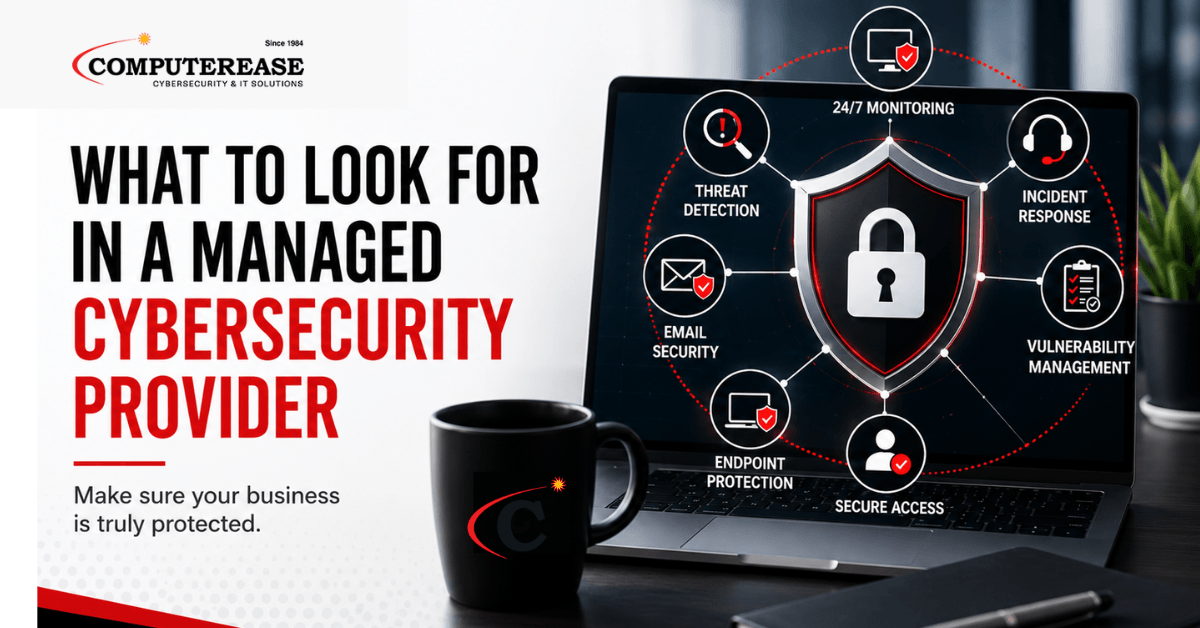
Most businesses assume that hiring an IT provider means cybersecurity is already covered. Unfortunately, that’s not always true.
Some managed service providers include a comprehensive cybersecurity program with continuous monitoring, threat detection, and incident response. Others provide little more than antivirus software and basic maintenance, leaving important protections as optional add-ons or not offering them at all.
The difference often isn’t obvious until after a security incident.
This guide explains what every business should look for before signing a managed cybersecurity contract, including the security services that should be included, the questions to ask, the certifications that matter, and the warning signs that a provider may not be delivering the protection your business actually needs.
MSP vs. MSSP: Know What You’re Actually Buying
Not every “managed IT” contract includes real cybersecurity. An MSP (managed service provider) traditionally focuses on uptime, hardware, software maintenance, and help desk support. An MSSP (managed security service provider) focuses specifically on threat detection, vulnerability management, and incident response, typically backed by 24/7 monitoring and dedicated security analysts.
Many businesses discover, only after an incident, that their “IT provider” never included real-time threat monitoring in the contract. Ask directly: does this agreement include SIEM monitoring, or is that a separate engagement? SIEM (Security Information and Event Management) is standard in true MSSP-level programs and frequently absent from general MSP contracts.
The Minimum Security Stack
Any provider handling business data should include the following as part of the base contract, not as line-item upsells added after signing:
- Endpoint Detection and Response (EDR): stops an attack before encryption or exfiltration completes
- Email security filtering with anti-phishing protection: email remains the mos common entry point for business compromise
- Firewall management with active rule review: revisited after install offers declining protection
- Automated patch management with defined deployment SLAs: unpatched software vulnerabilities are now a leading cause of breaches
- SIEM monitoring : centralized log visibility and threat correlation across your environment
If a provider positions any of these as optional, ask why. A credible security program does not treat detection and monitoring as upgrades.
Questions to Ask Before Signing
- What are your mean time to detect (MTTD) and mean time to respond (MTTR)? A provider that cannot give you a number does not track this internally, which means you will not know if they are improving.
- Do you monitor and respond, or just monitor and notify? Some providers stop at alerting you to a problem. Others isolate endpoints, disable compromised accounts, and coordinate the response directly. Get this distinction in writing.
- Can I see a sample incident response playbook? A mature provider has documented, repeatable response procedures, not an improvised process built during the incident itself.
- What compliance frameworks have you supported directly? If your business is subject to HIPAA, PCI DSS, or another regulatory framework, ask for specific, named client experience, not a general claim of “compliance expertise.”
- What does onboarding actually involve, and how long does it take? A realistic transition to a new security provider typically takes two to four weeks to properly baseline your environment. Providers promising same-week full coverage are cutting corners somewhere.
- Will we have a single accountable team, or will IT and security be handled by separate vendors who point fingers during an incident? Split accountability is one of the most common sources of delayed response during an actual breach.
Certifications and Credentials That Actually Matter
| Credential | What It Signals |
|---|---|
| SOC 2 Type II | Independently validated operational security controls, not just a self-reported claim |
| CISSP (individual) | Demonstrated, tested security expertise at the leadership or analyst level |
| CREST or GIAC (analyst-level) | Hands-on incident response and technical investigation capability |
| Industry-specific certifications (HITRUST for healthcare, CMMC-related credentials for defense contractors) | Direct experience with your specific regulatory environment |
| Microsoft Solutions Partner designation | Verified depth in the Microsoft 365 and Azure ecosystem most SMBs run on |
Certifications are not the whole picture, but their absence is a meaningful red flag. A provider unwilling to share analyst-level credentials or a SOC 2 report is asking you to trust claims it will not document.
Red Flags to Watch For
Vague pricing with security “unlocked” later. If EDR, SIEM, or incident response show up as add-ons after the sales conversation, the base offering was never a real security program.
No named response time commitments. “We respond quickly” is not a metric. A serious provider will commit to MTTD and MTTR figures in writing.
Reluctance to share a reference in your industry. A provider with genuine healthcare, legal, or financial services experience can point to it. One that cannot is likely newer to your compliance requirements than they are presenting.
Generic, one-size-fits-all contracts. A 10-person professional services firm and a 150-person manufacturer have different risk profiles. A provider offering the identical package to both has not actually assessed your environment.
No clear incident response ownership. If it is unclear who takes command during an active incident, your provider, your internal IT, or a third party, that ambiguity will cost you time during the event that matters most.
Managed Cybersecurity Provider Evaluation Checklist
- EDR, SIEM, email security, and patch management are included in the base contract, not sold separately later.
- The provider can state specific MTTD and MTTR figures.
- The provider distinguishes clearly between “monitor and notify” and “monitor and respond.”
- A sample incident response playbook is available for review.
- The provider has named, verifiable experience with your specific compliance framework.
- SOC 2 Type II or equivalent independent validation exists.
- Analyst-level certifications (CISSP, GIAC, CREST) are represented on the team.
- Onboarding timeline and process are clearly explained, not vague.
- A single team owns both detection and response, avoiding vendor finger-pointing.
- References from businesses of comparable size and industry are available.
How to Compare Multiple Providers Fairly
Request proposals from three to five providers using the same requirements document, so every quote covers identical scope. Build a simple comparison table across providers using these columns: base monthly cost, users and endpoints covered, included security stack, MTTD/MTTR commitments, compliance experience, and contract length. Comparing on price alone, without normalizing what is actually included, is the most common reason businesses end up under-protected despite paying a competitive rate.
Talk to a Local Team That Owns Both IT and Security
Computerease combines managed IT and cybersecurity under one accountable team, so there is no finger-pointing between vendors during an incident. Schedule a 15-minute discovery call to walk through your current setup and see exactly what a properly scoped security program should include.
Download Your Free AI Policy Template
Frequently Asked Questions
An MSP focuses primarily on uptime, hardware, and general IT support. An MSSP focuses specifically on threat detection, vulnerability management, and incident response, typically with 24/7 monitoring. Many providers, including co-managed arrangements, blend both models.
Cost varies significantly by company size, industry, and included services, which is exactly why comparing normalized, apples-to-apples proposals matters more than comparing sticker price alone.
Typically two to four weeks for a small to mid-sized business, covering endpoint onboarding, log integration, and establishing a security baseline for your environment.
It is not legally required, but it is one of the clearest independent signals that a provider’s internal controls have actually been tested rather than self-reported.
Response capability during a real incident, not detection technology alone. A provider with excellent tools but a slow or unclear response process still leaves you exposed during the window that matters most.
Key Takeaway
- A managed IT contract and a real cybersecurity program are not automatically the same thing; confirm SIEM and incident response are included, not add-ons.
- The strongest evaluation signal is whether a provider can name specific MTTD and MTTR figures, not general reassurance.
- SOC 2 Type II, CISSP, and analyst-level certifications indicate independently validated capability.
- Compare providers using a normalized requirements document, not price alone.
- Split accountability between separate IT and security vendors is a common source of slow response during real incidents.