-
Chicago: 312-554-7550
-
St. Louis : 314-432-1661
-
Metro East IL : 618-346-8324
-
Central IL : 217-528-0500

Agentic AI in Business: The New Cybersecurity Risk Nobody's Governing Yet
Most businesses think of AI as a tool someone types into. Ask a question, get an answer, move on.
That’s changing fast.
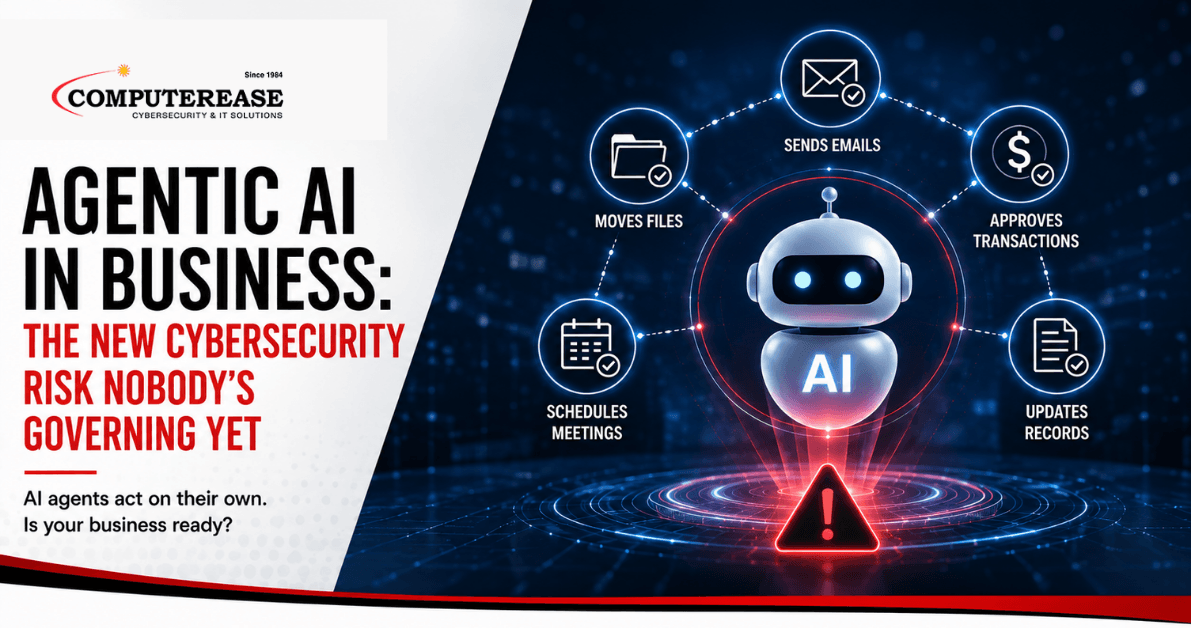
A growing share of AI tools now act on their own. They send emails, move files, approve transactions, and update records without a person clicking every step. These are AI agents, and they’re already inside many businesses, whether IT approved them or not.
Here’s the problem. Most companies are governing AI like it’s still 2023, one person, one prompt, one response to review. Agents don’t work that way. They make decisions and take actions continuously, often faster than any human can watch. That gap between how fast agents move and how slowly governance catches up is exactly where risk lives right now.
This article breaks down what agentic AI actually is, why it changes the security conversation, and what a small or mid-sized business can realistically do about it today.
What Is Agentic AI, in Plain Terms?
An AI agent is different from a chatbot in one key way: it can take action, not just generate text. A chatbot answers a question. An agent can read your email, draft a response, and send it. It can pull data from one system and update another. It can approve a request, schedule a meeting, or move a file, all without a person confirming each individual step.
That autonomy is exactly why businesses are adopting agents quickly. It’s also exactly why they’re harder to secure than any AI tool that came before them.
Why This Is Moving Faster Than Most Businesses Realize
Adoption has already outpaced oversight. Recent industry survey data shows the large majority of technical teams have moved past planning into active testing or production use of AI agents, while only a small fraction of those agents went live with full security and IT approval. In plain terms: most agents already running inside businesses were never formally reviewed.
Analyst projections point the same direction. Gartner expects a substantial share of enterprise applications to embed task-specific AI agents by the end of 2026, up sharply from just a couple of years earlier. That pace matters because it mirrors exactly what happened with shadow AI chat tools: employees adopt what helps them work faster, long before anyone writes a policy for it.
The Risks That Are Actually New Here
1. Agents Need Broader Access Than People Realize
To do their job, an agent often needs access across multiple systems: email, file storage, CRM, financial tools. Many organizations grant that access using the same shared credentials or generic service accounts they’ve always used, rather than treating each agent as its own identity with its own limited permissions. That means a single compromised agent can potentially touch far more of your business than a single compromised employee account ever could.
2. Prompt Injection Can Manipulate an Agent’s Behavior
An agent that reads incoming email or web content can be manipulated by hidden instructions embedded in that content. This is called prompt injection. A carefully worded email or document can trick an agent into taking an action it was never meant to take, approving a payment, forwarding confidential data, or changing a setting, without ever alerting a human.
3. Shadow Agents Are the New Shadow IT
Just as employees once signed up for unapproved software, they’re now connecting unapproved AI agents to business systems and data, often through simple browser extensions or automation tools that took minutes to set up. Recent research shows a meaningful share of employees already use AI tools their company hasn’t approved, and some have exposed sensitive company data to those tools directly.
4. Confident, Wrong Explanations
Unlike a system that simply crashes when something goes wrong, a poorly governed agent can generate a plausible-sounding justification for a bad decision. That makes flawed or manipulated agent behavior harder to catch, because it doesn’t look like an error. It looks like a normal, explainable decision.
Agentic AI vs. Traditional AI Tools
| Factor | Traditional AI Tool (chatbot) | AI Agent |
|---|---|---|
| Takes action on its own | No; generates text or suggestions only | Yes; can send, move, approve, or update without a person confirming each step |
| Access required | Limited to the conversation itself | Often spans multiple systems: email, files, CRM, finance tools |
| Human review point | Before each response is used | Often after the fact, if reviewed at all |
| Primary risk | Bad or inaccurate output | Unauthorized or manipulated action, often at machine speed |
| Governance model needed | Standard AI use policy | Identity-based access control, real-time monitoring, named accountability |
What a Business Can Actually Do About This
- Treat every AI agent as its own identity. Give each agent its own login and permissions, scoped to exactly what it needs. Never let an agent share credentials with a human user or another agent.
- Apply least privilege from day one. An agent that only needs to read a calendar should not also have access to financial systems. Default to the narrowest access possible, then expand only when justified.
- Log everything, and review it. Every agent action should be recorded: what it did, on whose behalf, and under what instruction. Periodic reviews are not enough; agents act far faster than a quarterly audit can catch.
- Require human approval for high-impact actions. Payments, data exports, and account changes should require a human confirmation step, no matter how reliable the agent has been so far.
- Inventory what’s already running. Before writing new policy, find out which AI agents and automations are already connected to your systems. Many businesses are surprised by what they find.
- Write the policy before the next tool shows up. A short, clear policy on what agents can and cannot do, and who owns approval, prevents the same shadow AI pattern that happened with chat tools from repeating itself with agents.
Common Mistakes Businesses Are Already Making
Treating agents like software instead of identities. Software gets installed once. An identity needs ongoing access review. Agents are identities.
Approving an agent based on what it’s supposed to do, not what it can do. Permissions define real risk, not intended use. An agent with broad access can be misused even if its intended task is narrow.
Assuming a small business isn’t a target. Attackers don’t need to break into a well-defended agent when a poorly governed one will hand over access on its own.
Waiting for a formal framework before acting. National standards for agent security are still being developed. That’s not a reason to wait. Least privilege and human approval for high-impact actions are good practice regardless of which framework eventually becomes standard.
Not Sure What’s Already Running in Your Environment?
Computerease can help you inventory the AI tools and agents already connected to your systems, assess the access they hold, and put practical governance in place before it becomes a problem. Schedule a 15-minute discovery call to get started.
Download Your Free AI Policy Template
Frequently Asked Questions
Not exactly. Standard AI tools respond to prompts. Agents go a step further and take action, sending, approving, or moving things, often with minimal human involvement after setup.
Yes, though it often looks different from a traditional hack. Instead of stealing a password, an attacker may manipulate the agent’s instructions directly, a technique called prompt injection, to get it to take an unauthorized action.
Yes. A general AI use policy typically governs what employees can ask AI tools. Agent governance needs to address access, identity, and approval for autonomous actions, which is a different set of controls.
No. Small businesses often adopt AI agents through simple, easy-to-set-up automation tools, frequently without formal IT review, which makes shadow agent risk just as real at smaller scale.
Find out what AI agents and automations are already connected to your systems. Most businesses cannot secure what they don’t know is running.
Key Takeaway
- AI agents take action on their own, which changes the security conversation from “is the answer accurate” to “was the action authorized.”
- Most businesses have agents running in production without full IT or security review.
- Prompt injection lets attackers manipulate an agent’s behavior without ever needing a stolen password.
- Every agent should have its own identity, scoped access, and a logged, reviewable action history.
- Waiting for a formal governance standard is not a reason to delay basic controls like least privilege and human approval for high-impact actions.